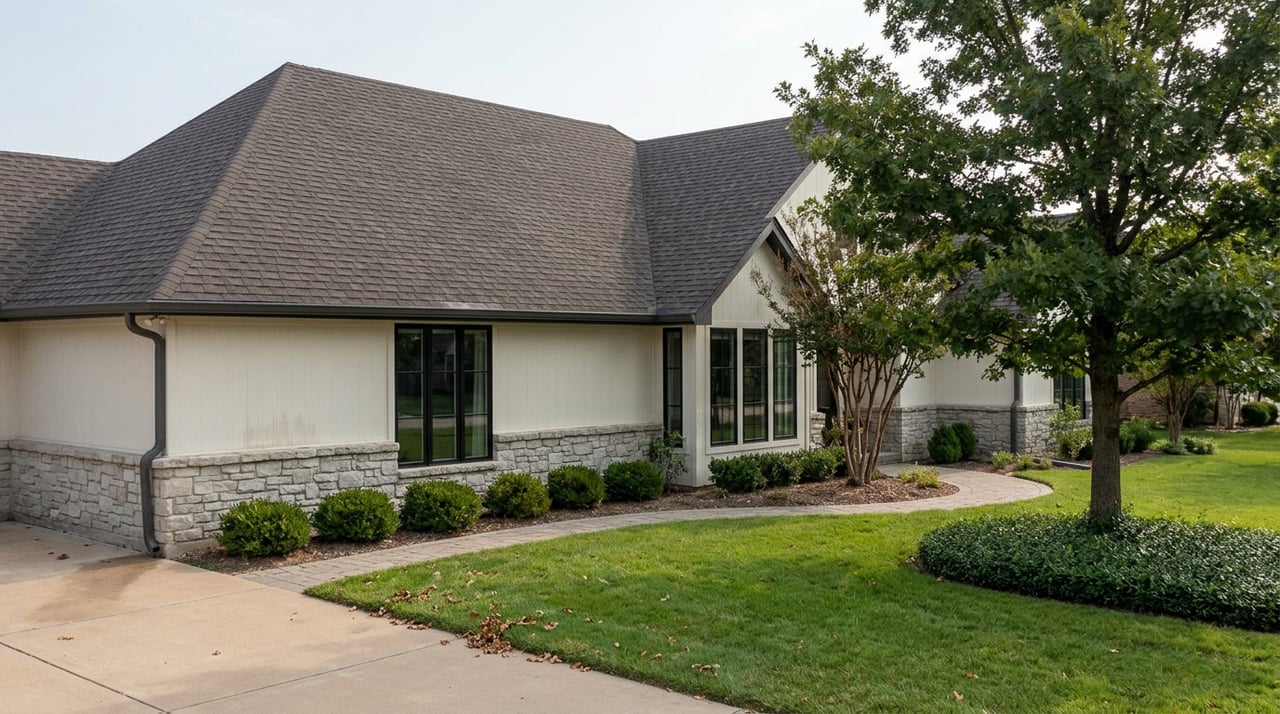
The Roof You Already Fixed Might Still Be a Problem in McKinney
September 10, 2026
September 10, 2026
A seller in Stonebridge Ranch calls her agent two weeks before a listing goes live. The roof got hit in the 2024 hail season, the claim was paid, a contractor patched one slope, and the invoice has been sitting in a drawer since. She assumes that box is checked. Then the agent asks a different question: what color and profile are the original shingles, and are they still being made?
She doesn't know. Nobody asks that question until they have to.
That question is the whole story for a specific slice of McKinney's housing stock right now, and it explains something the median price and days-on-market numbers never will: why a roof repair from two years ago can resurface as a disclosure problem the week you decide to sell.
Most homes built through McKinney's 2000s growth wave in neighborhoods like Stonebridge Ranch, Eldorado, and Craig Ranch are now old enough that their original shingle lines have been discontinued by manufacturers. That matters because Texas building code, adopted in most DFW jurisdictions, limits how much of a roof slope can be repaired in a 12-month window before the whole slope has to come off and get brought up to current code rather than patched. Contractors and adjusters refer to this as the 25 percent rule.
What catches sellers off guard is that the discontinued-shingle problem shows up even when a repair stays under that 25 percent threshold. If the original product line is gone, a patched slope can't be matched to the surrounding roof, and carriers will often agree to replace the full slope anyway on the basis that a visibly mismatched roof isn't a legitimate repair. That argument has nothing to do with square footage. It has to do with whether the shingle still exists on a shelf somewhere.
For homes in the Stonebridge Ranch and Eldorado age range, that argument is increasingly the rule rather than the exception. Roofing contractors working McKinney claims describe supplements from the 2024 hail season still moving through carriers well into 2026, largely because the original stock on those older homes can't be matched and the claim has to be reopened to convert a patch into a full-slope job.
Here's where the transaction risk actually lives. The Texas Real Estate Commission's current Seller's Disclosure Notice, Form 55-1, effective as of May 2026, added new questions that didn't exist on the prior version: whether the property is presently covered by insurance, whether it carries windstorm coverage, and whether the seller has ever been unable to insure the property for any reason. That last question is aimed directly at homes that have accumulated claims history in a hail corridor.
A seller who filed a hail claim years ago, had a slope patched, and never circled back to confirm the shingle match is now answering a disclosure form that asks about insurability, not just repair history. If a buyer's insurer pulls the property's CLUE record and sees a claim the seller described as fully resolved, but the roof still shows an unmatched patch or an unconverted partial repair, that gap becomes the buyer's first question and the seller's first liability. Texas courts have also held that a seller's duty to disclose doesn't end when the form is signed. In one Texas appellate case, a seller who experienced hail damage after completing a disclosure form, but before delivering it to the buyer, was found to have an ongoing obligation to update it. The lesson travels forward: a roof issue doesn't get simpler by staying quiet longer.
McKinney's housing stock skews toward a median home age of roughly 20 years, which means a large share of the city's roofs are aging into this exact window at the same time. That produces two very different situations depending on which side of town a home sits on.
The April 2026 severe weather stretch, which produced hail up to softball size across Collin, Dallas, Tarrant, and Denton counties over six days, gave the newer side of town its introduction to this process. A first-time claim on a Trinity Falls or Tucker Hill roof is a simpler conversation today. In eight to ten years, when that shingle line is also discontinued, it becomes the same conversation Stonebridge Ranch is having now.
Sellers in the older subdivisions have a narrow window to get ahead of this rather than let a buyer's inspector or insurer surface it first.
None of this requires new construction or a full remodel. It requires closing the loop on a claim that already happened, before a disclosure form or a CLUE pull does it for you in front of a buyer.
If my roof was already repaired and the leak never came back, do I still have to disclose the original hail claim? Yes. Texas disclosure practice treats the claim itself as a material fact separate from whether the repair held up. Even a fully resolved, insurance-paid repair is something the form asks about, and the claim history will also show up independently in a CLUE report a buyer's insurer pulls.
What if my insurance company already dropped my roof coverage or moved me to a higher-rate policy? That is now a direct question on the current TREC disclosure form. Since several major carriers have pulled back on coverage for homes with older roofs or prior claims in hail-prone areas, this question exists specifically to surface properties that may be harder or more expensive for a new buyer to insure.
Does a full roof replacement always follow a hail claim on an older McKinney home? Not automatically. The 25 percent rule is a code threshold tied to how much of a slope is damaged within 12 months, and it is a real trigger, but the matching-shingle problem is a separate issue that can force a full-slope replacement even on lower-damage claims once the original product is discontinued. Every claim still comes down to documentation of the actual damage and the actual availability of matching material.
If you're weighing whether to sell a home in Stonebridge Ranch, Eldorado, or anywhere else in McKinney with a roof that has a claims history, it's worth getting ahead of the disclosure and insurability questions before a buyer's agent asks them for you. Weidler Group works with sellers across McKinney and the northern Collin County suburbs to get that kind of detail sorted early, so the listing tells a clean story from day one. Reach out to start a conversation about your home's specific timeline and get a clear read on what buyers and their insurers will actually be looking for.
As your trusted guide, you're not just acquiring a property; you're uncovering a home that encapsulates your dreams and aspirations.