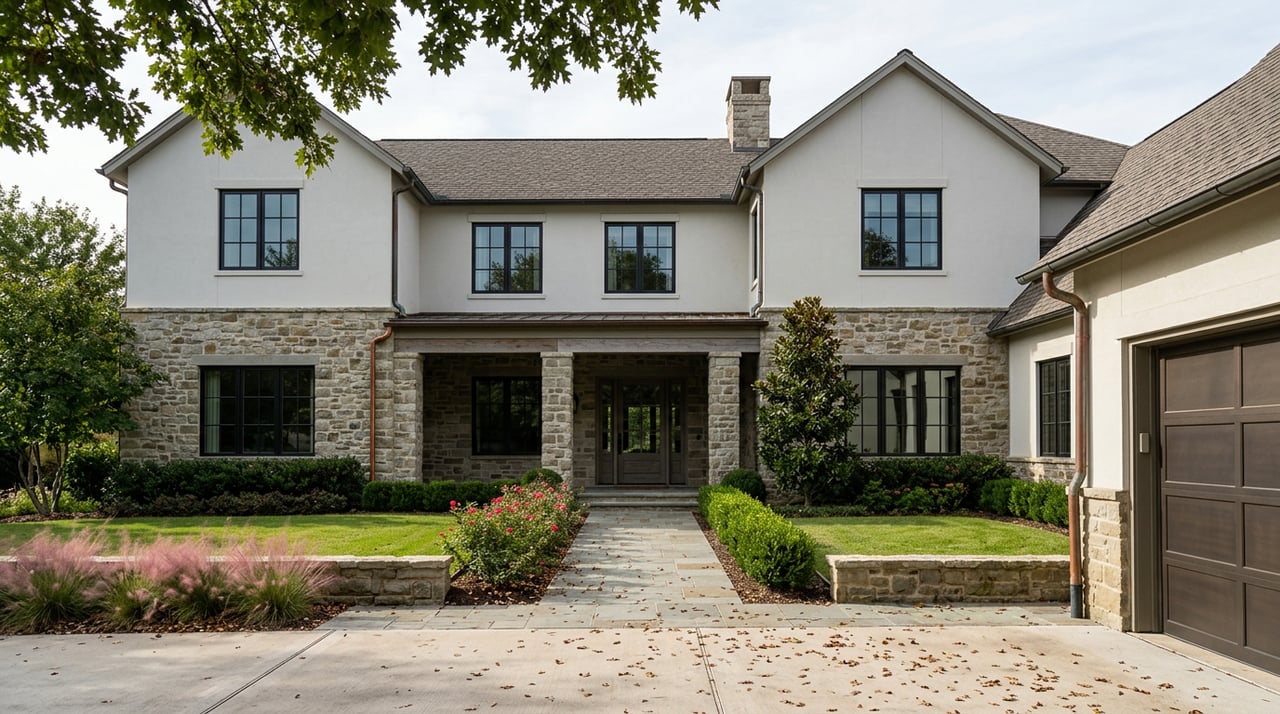
Why Frisco’s Median Home Price Doesn’t Tell the Whole Story
September 17, 2026
September 17, 2026
Two of the most widely cited home-price trackers agree almost to the dollar on what a home in Frisco costs right now. Redfin's three-month median, covering the period ending July 2026, put the figure at $675,000. Zillow's home value index, as of late July 2026, put the typical Frisco home at $673,986. That kind of agreement usually reads as confidence, two independent methodologies landing within about $1,000 of each other. It should read as a warning instead. A number that precise is only possible by blending a $350,000 condo market with a $25 million estate market and calling the result one city.
Most comparison content built around that median does something similar: it lines Frisco up against McKinney, notes a gap of somewhere between $165,000 and $183,000, and calls it a day. That gap is real. But it is not the number that should decide where you buy, because it is smaller, in some cases much smaller, than the price spread you can find inside Frisco's own city limits, sometimes inside the same master-planned community.
Start with Fields Frisco, the master-planned community built around the PGA of America's relocated headquarters and the Omni PGA Frisco Resort & Spa, a 660-acre property that opened on May 2, 2023. Fields is organized into four distinct villages: East Village, Brookside, The Preserve, and Fields West. Builders active across those villages include Toll Brothers, Landon Homes, and Brookfield Residential, the last of which is expanding phases at The Grove Frisco.
List prices across those four villages run from around $600,000 to $25 million. That is not a typo and it is not four different subdivisions being loosely grouped under one marketing name. It is one master-planned community with a $24.4 million internal spread, wider than the entire price gap most buyers use to decide whether Frisco or McKinney is the smarter move.
The entry-priced village has also posted the strongest percentage appreciation of the four, mostly because it started from a lower base and had more room to climb. That is worth sitting with if you are comparing "Frisco" as a single line item against another city's single line item. You are not comparing two cities. You are comparing a citywide blend against a citywide blend, and one of those blends contains a $600,000 townhome and a $25 million estate under the same homeowners association banner.
Zoom out from Fields and the pattern holds across the rest of the city. Here is roughly how the range breaks down by the kind of Frisco a buyer is actually shopping for:
| Submarket | Typical price range | What defines it |
|---|---|---|
| Condos and townhomes near Frisco Square and The Star | $350,000 to $550,000 | Walkable, newer construction, smaller lots, proximity to the Cowboys' headquarters district |
| Fields Frisco, East Village | From about $600,000 | New construction, entry point into the PGA and resort-anchored community |
| Gated legacy communities: Starwood, Newman Village, Hills of Kingswood | $1.5 million to $3 million+ | Larger estate lots, established landscaping, private access |
| Fields Frisco, The Preserve | Up to $25 million | Custom estates, golf course frontage, resort-adjacent |
A citywide median collapses all four of those rows into a single figure. That figure is not fictional. It is just a blend of things that do not blend well, like combining the temperatures of an oven and a freezer into one number that tells you nothing useful about either one.
Part of the answer is age of inventory. Frisco's housing stock skews new relative to most of North Texas, but "new" covers a 25-year build-out, and the neighborhoods platted in the early 2000s now sit at a very different price point than the phases breaking ground this year next to a PGA-branded resort district.
The other part is what each pocket of the city is actually selling. A condo near Frisco Square is selling walkability and proximity to the entertainment district. A home in Starwood is selling a gated, established, low-turnover community with mature landscaping that a brand-new subdivision cannot replicate at any price. A home in Fields Frisco is selling access to a resort amenity package, championship golf, and a still-developing address that some buyers treat as ground-floor positioning. These are not competing products. They are different products that happen to share a city name and a school district boundary in most, though not all, cases.
That matters because Frisco Independent School District is not the only district serving Frisco addresses. Parcels also fall under Prosper ISD, Lewisville ISD, and Little Elm ISD depending on location, which is one more reason a citywide price average obscures more than it reveals. The subdivision, not the city, is doing almost all of the work in determining what a given address actually costs and what district it lands in.
The Frisco-versus-McKinney debate everyone runs is the wrong first comparison. The comparison that actually matters is Frisco-versus-Frisco.
None of this erases the real gap between Frisco and McKinney. Multiple 2026 sources converge on a difference of roughly $165,000 to $183,000 between the two cities' medians, and the reasoning behind that gap holds up: Frisco's housing stock is newer on average, its commercial tax base includes corporate campuses and entertainment anchors that McKinney does not have at the same density, and proximity to those employers carries real value for buyers who work there.
Frisco was ranked the top real estate market in the country for 2026 in WalletHub's annual study, edging out McKinney, which had held that top spot for three years running, according to CultureMap Dallas. That ranking measured housing market attractiveness, home value forecasts, affordability, and population growth across 300 U.S. cities. It is a legitimate data point. It is also a citywide score, and citywide scores are exactly the thing this whole piece is arguing you should not treat as decision-grade information for a specific purchase.
Here is the reframe: the Frisco-McKinney gap is a headline number that is smaller than the gap between two neighborhoods that are both, technically, "in Frisco." If you are choosing a city based on a $175,000 difference, you should be doing the same math one level down, because the stakes inside Frisco are frequently higher than the stakes between Frisco and its neighbor to the northeast.
If you are a move-up family or a relocating professional using a citywide median to budget, the practical fix is to stop budgeting against the city and start budgeting against the specific pocket you are actually considering. A few things that follow from the data above:
Is Frisco overpriced compared to McKinney? Not necessarily. The roughly $165,000 to $183,000 median gap reflects real differences in housing stock age and proximity to employment centers. Whether that premium is worth it depends entirely on which Frisco neighborhood you are pricing against which McKinney neighborhood, not the two citywide averages.
Does a lower price inside Fields Frisco mean lower quality? Not based on what the appreciation data shows. The most affordably priced village in Fields has posted the strongest percentage gains of the four, which suggests the market is pricing in future upside on the entry tier rather than treating it as a lesser product.
Should I even look at Frisco's citywide median? Use it as a starting orientation, not a budgeting tool. Once you know roughly which type of Frisco you want, the townhome-and-Star corridor, an established resale neighborhood, or a gated estate community, the citywide figure stops being useful and the submarket figure becomes the only one worth tracking.
If you are trying to figure out which Frisco actually fits your budget, your commute, and the way you want to live day to day, that is exactly the kind of neighborhood-level read a citywide chart cannot give you. Weidler Group works these submarkets directly and can walk you through what a given price point actually buys block by block, not city by city. Reach out to start that conversation before you anchor on a number that was never describing your Frisco to begin with.
As your trusted guide, you're not just acquiring a property; you're uncovering a home that encapsulates your dreams and aspirations.