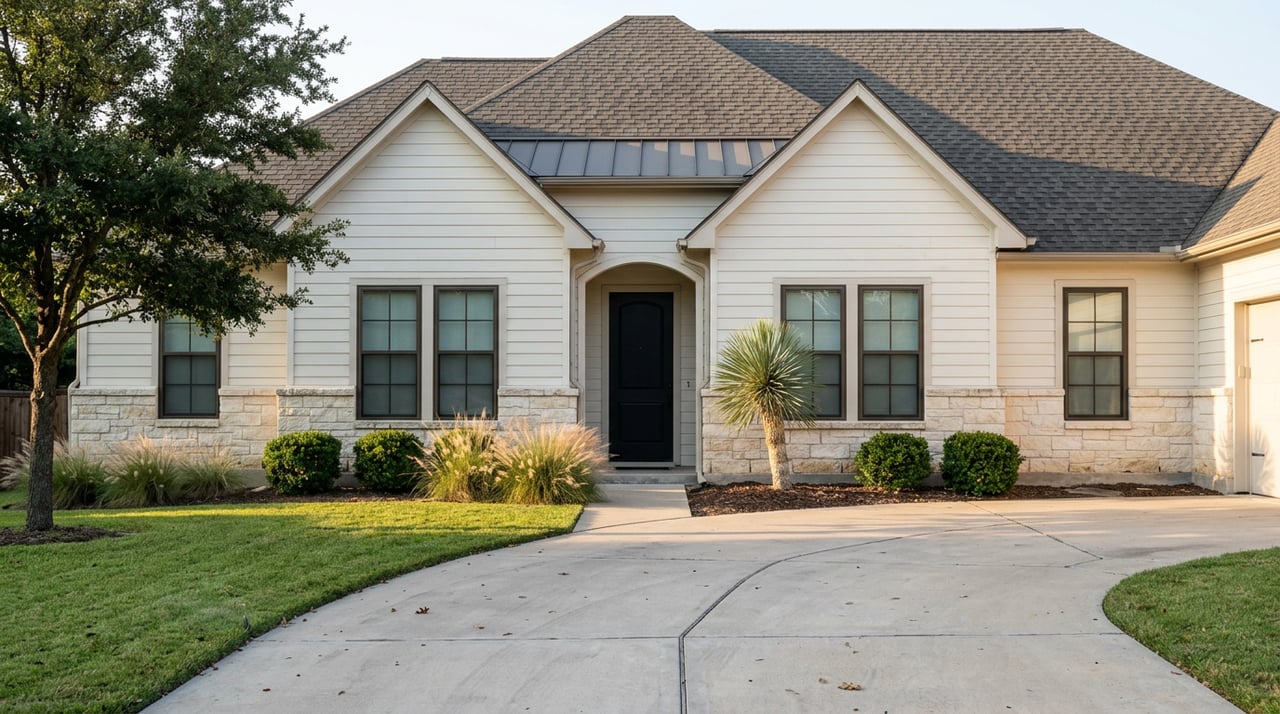
Trinity Falls vs Tucker Hill Property Taxes in McKinney
August 13, 2026
August 13, 2026
Two buyers pull up listings ten minutes apart. Both homes sit in McKinney. Both are five years old, roughly 3,400 square feet, priced in the high $800s. Both show up in a portal search as "McKinney, TX." On paper, they look like the same purchase with a different floor plan.
They are not the same purchase. One of these buyers is about to sign up for a tax bill that runs several thousand dollars a year higher than the other, and the difference has nothing to do with the home itself.
The two communities are Trinity Falls and Tucker Hill, and the gap between them is a clean lesson in how McKinney's growth actually got financed. Most guides to master-planned communities warn buyers about the wrong thing when it comes to taxes. The instinct is to treat a Municipal Utility District like the villain and a plain city address like the safe choice. The real story is more specific than that, and more useful if you're comparing two communities in the same price band.
Trinity Falls sits outside McKinney's city limits, in the city's extraterritorial jurisdiction. It's governed for tax purposes by McKinney MUD 1 and McKinney MUD 2, municipal utility districts created to fund the water, sewer, drainage, and road infrastructure for the community's roughly 5,400 planned homes. Because it's outside city limits, Trinity Falls residents pay no City of McKinney property tax at all. Instead they pay the MUD's own ad valorem rate, which functions like a tax and shows up on the same bill, and they're zoned to McKinney ISD.
Tucker Hill is the opposite setup in almost every way. It sits inside McKinney's actual city limits, off West University Drive between Custer and Ridge Roads, and carries no MUD, no PID, and no special assessment district of any kind. Residents pay the standard City of McKinney rate. But Tucker Hill isn't zoned to McKinney ISD. It's zoned to Prosper ISD, an artifact of how the district's boundaries were drawn well before the neighborhood existed.
That second fact catches people off guard more than the first one. A buyer who assumes "inside the city" means "same school taxes as every other McKinney address" is working from a map that doesn't match the tax roll.
A third structure exists in the market too, worth knowing even if it's not part of this specific comparison. Craig Ranch finances its infrastructure through a Public Improvement District, which works differently than either of the above. A PID is a fixed-dollar assessment lien attached to a specific lot, not a rate that scales with your home's appraised value the way a MUD or ISD tax does. It can be paid off in a lump sum at closing or amortized over the term, and once it's paid, it's gone permanently. A MUD rate, by contrast, keeps applying to your home's value for as long as you own it, adjusting up or down as the district's debt service and appraised values shift.
Three communities, three different financing mechanisms, three different ways your tax bill gets built.
Here's how the actual FY2025-26 adopted rates stack up per $100 of assessed value, pulled from each taxing entity's own adopted budget:
| Taxing Entity | Trinity Falls | Tucker Hill |
|---|---|---|
| City / District | McKinney MUD 1: $0.9847 | City of McKinney: $0.412284 |
| School District | McKinney ISD: $1.1043 | Prosper ISD: $1.2141 |
| County | Collin County: $0.149343 | Collin County: $0.149343 |
| College | Collin College: $0.08122 | Collin College: $0.08122 |
| Combined rate | ≈$2.32 | ≈$1.86 |
Every one of those figures comes from FY2025-26 adopted budgets reported across Collin County and McKinney MUD 1's own rate history, which is worth checking yourself before you write an offer, because these numbers move every fall.
Now look at the line most buyers assume is doing the work. McKinney ISD's rate is actually lower than Prosper ISD's, by about 11 cents per $100. If school district taxes were the whole story, Trinity Falls would win on that line and Tucker Hill would lose. But it isn't the whole story. The MUD's debt-service rate alone runs more than double the City of McKinney's rate, and that single line more than erases the school district advantage Trinity Falls holds. The MUD, not the school district, is doing almost all of the work in this comparison.
Run both rate stacks against a $900,000 assessed value, a realistic number for either community given Weidler Group's typical price band:
Trinity Falls: $20,878 a year in combined property taxes, before any homestead exemption.
Tucker Hill: $16,714 a year in combined property taxes, before any homestead exemption.
That's a $4,164 annual difference, or about $347 a month, for two homes that could otherwise be identical on square footage, lot size, and finish level. Neither of those figures includes each community's HOA dues, which run on their own separate schedule and aren't part of the tax roll at all.
Texas voters approved Proposition 13 in November 2025, raising the mandatory school district homestead exemption from $100,000 to $140,000 for the 2026 tax year. Most coverage framed this as broad relief for homeowners, and it is. What it doesn't do is treat every school district the same.
The exemption knocks $140,000 off the value your school district can tax, but the dollar value of that break depends on the rate applied to it. Run it through both scenarios: the $140,000 exemption saves a Trinity Falls homeowner about $1,546 a year against McKinney ISD's rate. It saves a Tucker Hill homeowner about $1,700 a year against Prosper ISD's higher rate. Tucker Hill's homeowner gets the bigger dollar break precisely because Prosper ISD's rate is higher to begin with.
Run the full math with the exemption applied and the gap between these two communities doesn't shrink. It widens slightly, to roughly $4,317 a year. A tax relief measure built to help homeowners across the board ends up amplifying the price gap between two communities that already sit on opposite sides of it. That's not a flaw in the policy. It's just what happens when a flat-dollar exemption interacts with two different rates, and it's the kind of detail that only shows up when you actually run both scenarios instead of trusting a single average.
A few things worth carrying into any comparison shopping between McKinney-area communities:
None of this makes one structure objectively better than another. A MUD funds real infrastructure that a buyer is using every day, and a PID pays for amenities a straight city tax roll wouldn't cover on its own. The point isn't which mechanism wins. It's that the mechanism itself, not the school district everyone assumes is driving the number, is usually the reason two similarly priced McKinney homes carry two very different bills.
Does a MUD tax rate ever go away? No, not the way a PID assessment does. A MUD is a permanent taxing entity as long as the district exists, though its rate typically declines over time as infrastructure bonds get paid down.
Is a PID the same thing as an HOA? No. An HOA is a private association charging dues for community management and amenities. A PID is a public taxing mechanism created under Chapter 372 of the Texas Local Government Code, and the assessment shows up on your county tax bill rather than an HOA invoice.
How do I find out if a specific address carries a MUD or PID? The Collin Central Appraisal District's property search tool will show every taxing entity attached to a given address, and it's worth checking before you tour a home, not after you've made an offer.
Comparing two McKinney communities on price alone tells you less than it feels like it does. If you're weighing Trinity Falls against Tucker Hill, or any other pair of communities where the sticker price looks similar and the tax structure doesn't, that's exactly the kind of math Weidler Group runs before a client ever writes an offer. Sell a Lifestyle. Request your home valuation and let's talk through what a specific address actually costs to own.
As your trusted guide, you're not just acquiring a property; you're uncovering a home that encapsulates your dreams and aspirations.